Why Space & Aerospace Startups Need a Website Built Like Mission Hardware

TL;DR: Space and aerospace audiences (engineers, investors, agencies) can spot a themed template in seconds. A custom-built site or dashboard — on a one-time fee, with full source code ownership — holds up to that scrutiny and never locks you into a subscription.
If you're building a space startup, running a satellite constellation, or supplying hardware to the aerospace industry, your website is doing more than "looking nice." It's often the first technical artifact a potential investor, partner, or engineer evaluates about your team — before they ever see your hardware.
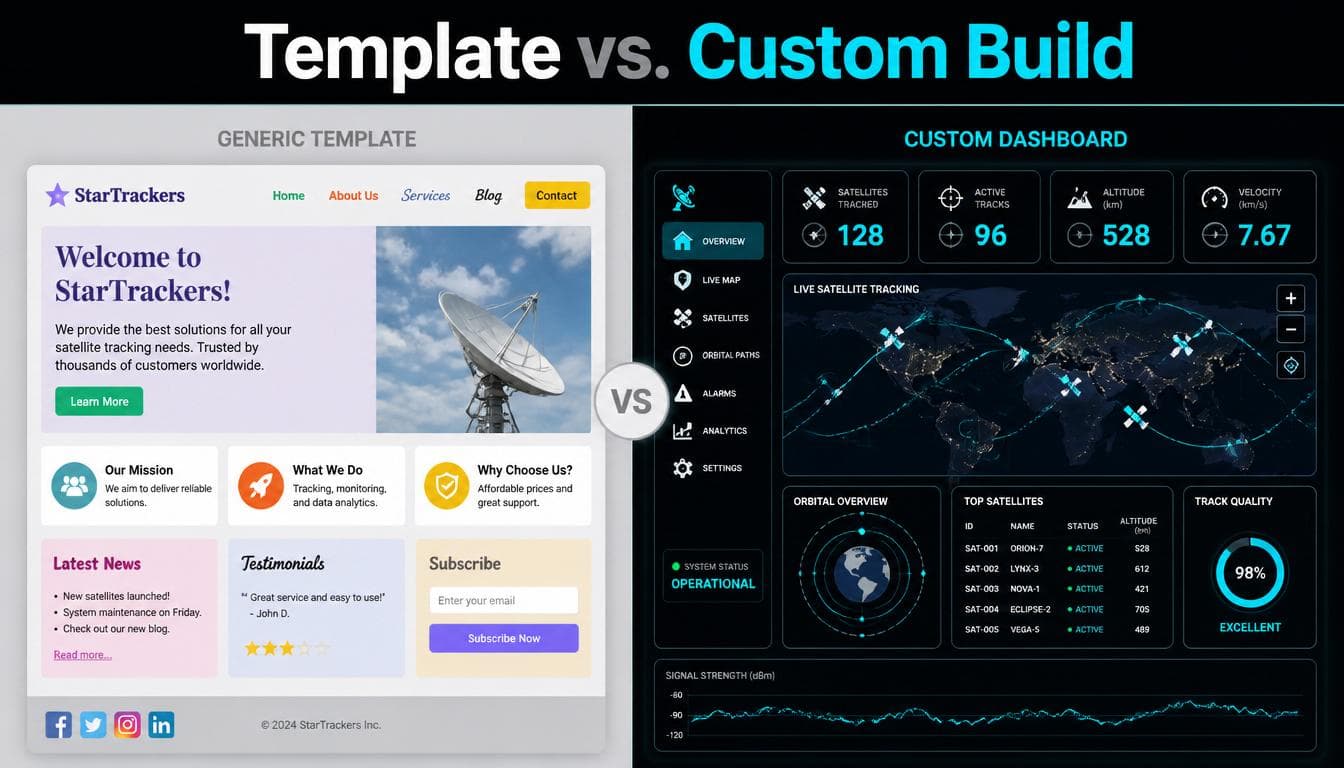
That's a different bar than a typical small-business site. A generic page builder or theme signals exactly the opposite of what you want a technical audience to believe about your operation.
The problem with templated sites for space companies
Most website builders are optimized for restaurants, gyms, and local services — not for showing telemetry data, orbital passes, or mission timelines. When a space startup tries to force that kind of content into a generic template, a few things usually go wrong:
- No real data visualization — drag-and-drop builders can't render live satellite health, pass schedules, or mission dashboards
- Slow load times — bloated template code hurts credibility with technical visitors who notice performance immediately
- Monthly lock-in — subscription page builders keep charging indefinitely, and you never own the underlying code
- No path to internal tools — once you need a ground-station scheduler or investor data room, templates simply can't get there
What a real space & aerospace web build covers
A properly built system for a space or aerospace team usually falls into one of six categories, each solving a different operational need:
| What you need | What it looks like |
|---|---|
| Marketing site / landing page | Fast, credible company site ready before a funding round |
| Data visualization dashboard | Live tracking portal for satellite health and pass schedules |
| Internal tools | Ground-station scheduling, fleet management, mission planning |
| E-commerce | Store for mission-patch merch or licensed data products |
| Education / community platform | Members-only hub for a university CubeSat program |
| Investor / compliance portal | Access-controlled data room for export-control-sensitive materials |
Why one-time fee, full source ownership matters here specifically
Aerospace and space companies deal with investors, technical due diligence, and sometimes export-control review. A vendor who holds your codebase hostage behind a monthly subscription — or who won't hand over clean source code — is a liability during diligence, not a convenience.
That's the entire premise behind a one-time build fee: you pay once, the full codebase ships to your own GitHub repo, and nothing breaks if the original builder is no longer involved. You can deploy it on Vercel, your own hosting, or a free-tier host — that part is entirely your call.

A live example: Orbit Watch
One useful way to judge a builder's capability with space data is to look at a real, shipped project rather than a mockup. Orbit Watch is a live ISS and satellite tracker — a real-time 3D orbital map built from public TLE (Two-Line Element) data, with visible-pass predictions for any location, free and with no signup required.
That kind of build — 3D orbital visualization, live tracking, pass prediction — is available as a ready-made tier, or as the starting template for something fully custom to your mission.
See Space & Aerospace Web Development →Getting started
Whether you need a public marketing site before a raise, an internal ground-station tool, or a gated investor data room, the process starts the same way: tell us what you're building, and we scope a one-time build fee with full source code ownership from there.
Get Your Space Project →Prefer to order directly instead of a custom scope conversation? The ready-made ISS/satellite tracker tiers shown on the Space & Aerospace page are also available straight from the Fiverr gig:
Order on Fiverr →